April 1, 2021
What muscles does the exercise bike exercise and how to train them?
The exercise bike is a key ally for improving fitness and health. But what muscles do you really work when pedaling and how can you get the most out of them? In this article we tell you, with practical tips to optimize your training.

Exercise cycling is an excellent cardiovascular exercise, available to all types of users, from professionals to beginners. The different degrees of pedaling resistance that can be configured allow for more or less demanding workouts.
Among the many benefits of exercise cycling are muscle toning and development, especially in the legs, abdomen and buttocks, and with it the achievement of a more athletic and healthy figure. Do you want to learn more about which muscles are exercised with an exercise bike? Then keep reading this post, where you will also find effective workout routines to strengthen muscles and burn calories practicing with an indoor exercise bike.
Among the many benefits of exercise cycling are muscle toning and development, especially in the legs, abdomen and buttocks, and with it the achievement of a more athletic and healthy figure. Do you want to learn more about which muscles are exercised with an exercise bike? Then keep reading this post, where you will also find effective workout routines to strengthen muscles and burn calories practicing with an indoor exercise bike.
Exercise bike training: muscles involved
Beyond the benefits for the heart- since indoor cycling is, above all, a cardio workout - it primarily engages the muscles of the lower body: legs, thighs, and glutes. The abdominals and back are also activated to support posture and stability throughout the ride.
EXERCISE BIKE TRAINING: LOWER-BODY MUSCLES INVOLVED
EXERCISE BIKE TRAINING: UPPER-BODY MUSCLES INVOLVED
However, the thigh muscles (quads and glutes) get less of a workout because your entire body weight is driving the pedaling, so your legs do less work.
Make sure your posture on the exercise bike is correct and that the saddle is set at the right height. Proper positioning helps you pedal comfortably and reduces the risk of issues such as muscle soreness or tendonitis.
EXERCISE BIKE TRAINING: LOWER-BODY MUSCLES INVOLVED
- Quadriceps and hamstrings: these muscles are found respectively in the front and back of the thighs, and are constantly working when you pedal on an exercise bike. The quadriceps are responsible for straightening the leg and pushing the pedal to the floor. For their part, the hamstrings are muscles that work by contracting the leg during pedaling.
- The muscles of the gluteal region—gluteus maximus, medius, and minimus—are activated while pedaling in a seated position, but their involvement increases significantly when riding out of the saddle.
- Triceps surae: This muscle group, actively engaged during cycling, is located on the back of the lower leg, spanning from the knee to the ankle—commonly referred to as the calf. It consists of the gastrocnemius and the soleus muscles and connects to the heel via the calcaneal tendon, more widely known as the Achilles tendon. The triceps surae plays a key role during the final push phase of the pedal stroke, after the quadriceps have completed their primary action.
EXERCISE BIKE TRAINING: UPPER-BODY MUSCLES INVOLVED
- Abdominal muscles (the lesser and greater oblique, transvers,e and rectus abdominis muscles ): they ensure correct posture and balance of the pelvis and spine on the exercise bike.
- Back muscles: the quadratus lumborum and iliopsoas also help maintain posture and support the spine.
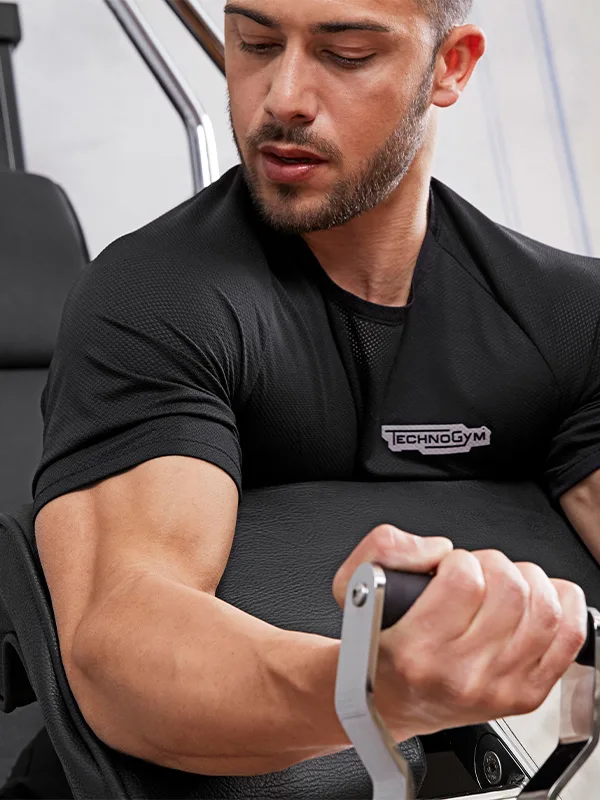
- Biceps and triceps: these muscles in the front and back of the arms work when gripping the handlebars of the exercise bike. These muscles are exercised more intensely the tighter you grip the handlebars of the exercise bike, which happens when sprinting or pedaling off the saddle with high resistance. When pedaling while standing, more pressure is exerted on both the arm muscles (biceps and triceps) and the lower back muscles.
However, the thigh muscles (quads and glutes) get less of a workout because your entire body weight is driving the pedaling, so your legs do less work.
Make sure your posture on the exercise bike is correct and that the saddle is set at the right height. Proper positioning helps you pedal comfortably and reduces the risk of issues such as muscle soreness or tendonitis.

The heart: the most important muscle trained with an exercise bike
We have left it for last, but that does not mean that it is the least important. On the contrary. Although you will not physically see the results, as in the rest of the muscles we have just listed, training with an exercise bike will exercise and strengthen this important muscle of our body. The heart is responsible for carrying oxygen to the cells of our body by pumping blood.
Aerobic training, such as exercising on an exercise bike, increases the body’s demand for oxygen and invites the heart to do what it does best: adapt, become more efficient, and grow stronger. Beat after beat, the heart learns to pump more blood with less effort, supporting every movement with greater harmony. Over time and with consistency, this balance evolves into increased endurance and stronger cardiovascular health—sustaining well-being in everyday life.
Aerobic training, such as exercising on an exercise bike, increases the body’s demand for oxygen and invites the heart to do what it does best: adapt, become more efficient, and grow stronger. Beat after beat, the heart learns to pump more blood with less effort, supporting every movement with greater harmony. Over time and with consistency, this balance evolves into increased endurance and stronger cardiovascular health—sustaining well-being in everyday life.


What is the correct position on an exercise bike?
Adjusting your exercise bike correctly and maintaining good posture is essential to avoid injury, overloading and soreness in your muscles. Don't let poor posture ruin all the benefits of exercise cycling!To do this, it is important to make the following adjustments.
A good adjustment of the saddle height and horizontal position reduces the risk of discomfort when pedaling and the likelihood of strained knees.
The height and proximity of your exercise bike 's handlebars is also critical to avoid straining your muscles when you train. To determine if the handlebar position is correct you should be able to maintain trunk alignment, and the arms should provide a secure grip in the various positions, keeping the elbows slightly bent. That is, the arms should not be fully extended.For people with back problems and pregnant women, it is advisable to set the handlebar height above that of the saddle. However, it is advisable to consult a doctor beforehand as to the most appropriate way to use an exercise bike in any of these cases.Now that we have the handlebars and saddle correctly positioned, it is time to get on the exercise bike and find the safest position.
If you have correctly positioned the handlebars and saddle on your exercise bike, you are guaranteed to have a correct posture once you get on the exercise bike. However, here are some tips and tricks that will help you.
ADJUSTING THE EXERCISE BIKE SADDLE
A good adjustment of the saddle height and horizontal position reduces the risk of discomfort when pedaling and the likelihood of strained knees.
- Saddle height: to know if we have the saddle at the correct height, we must be able to fully extend the knee, placing our heel on the pedal located in the 6 o'clock position. In this way, when pedaling we support the middle of the foot, the knee will be slightly flexed. To make sure that we have placed the saddle of our exercise bikeat the correct height, after having taken the step just explained, we will raise the pedal to 12 o'clock to check that the knee is at the height of the hip joint or slightly below it. Ready, you have the saddle of your exercise bikeat the correct height! Now let's see what is the best longitudinal position.
- Horizontal position of the saddle: if your exercise bikeallows this adjustment, it is advisable to do so, as the comfort when training on your exercise bikewill be greater. Position the pedal at 9 o'clock and check that your knee does not protrude beyond the tip of your toes.
ADJUSTING THE HANDLEBARS ON THE EXERCISE BIKE
The height and proximity of your exercise bike 's handlebars is also critical to avoid straining your muscles when you train. To determine if the handlebar position is correct you should be able to maintain trunk alignment, and the arms should provide a secure grip in the various positions, keeping the elbows slightly bent. That is, the arms should not be fully extended.For people with back problems and pregnant women, it is advisable to set the handlebar height above that of the saddle. However, it is advisable to consult a doctor beforehand as to the most appropriate way to use an exercise bike in any of these cases.Now that we have the handlebars and saddle correctly positioned, it is time to get on the exercise bike and find the safest position.
CORRECT POSTURE ONCE ON THE EXERCISE BIKE
If you have correctly positioned the handlebars and saddle on your exercise bike, you are guaranteed to have a correct posture once you get on the exercise bike. However, here are some tips and tricks that will help you.
- In case you are a beginner or want to make sure that you maintain the correct back curvatures, a good idea is to train next to a mirror. This way you can correct your posture and improve it little by little.
- Avoid pedaling with the toe of your foot: this is a common mistake when cycling stationary. The correct thing to do is to pedal with the sole of the foot, otherwise we will modify our posture when pedaling and we may end up having pain in the muscles. The best way to ensure good posture when placing your foot on the exercise bike pedal is to use indoor cycling shoes with cleats. The velcro or straps of some pedals can cause us to unconsciously pull up with our foot, overloading the iliopsoas.
- Do not use force with your arms: the function of the arms is to hold the handlebars and give us stability. If you put too much pressure on your handlebars, you will change the correct posture. Your arms should be semi-flexed, with your shoulders low and relaxed.
- Don't point your elbows outward: a common mistake that causes forearms and wrists to tighten. Keep your elbows parallel to your trunk and pointing backwards.
How long does it take to build muscle on an exercise bike?
First of all, you should know that your muscles need resistance to work on your exercise bike. Therefore, the more you increase the pedaling resistance, the more force you will have to exert and the more you will strengthen your muscles. On the contrary, if the pedaling resistance is low, you will hardly be able to increase your muscle mass.
As you know, the key to all sports is consistency. Practicing stationary cycling you will not get toned legs overnight. You will get this result by training regularly and you will see results after a few weeks. Be patient and persistent and your efforts will pay off. If you want to keep track of how your muscles are evolving, you can do it with a body fat measurement scale.
Normally the first results start to become visible after a few weeks, approximately 4 to 6 weeks. You will see how your legs, thighs and buttocks are firmer. You will also notice how your workouts become easier and less demanding than when you started training. After 6 weeks you should continue to work at the same pace and occasionally increase both the duration and intensity of your workouts, but not too much, as this could negatively impact your motivation. After two to three months you will clearly see how much more muscular your legs, muscles and glutes are than when you started exercising on your exercise bike. Your muscle mass will have increased and fat will have decreased, giving your body a much more athletic shape.
As you know, the key to all sports is consistency. Practicing stationary cycling you will not get toned legs overnight. You will get this result by training regularly and you will see results after a few weeks. Be patient and persistent and your efforts will pay off. If you want to keep track of how your muscles are evolving, you can do it with a body fat measurement scale.
Normally the first results start to become visible after a few weeks, approximately 4 to 6 weeks. You will see how your legs, thighs and buttocks are firmer. You will also notice how your workouts become easier and less demanding than when you started training. After 6 weeks you should continue to work at the same pace and occasionally increase both the duration and intensity of your workouts, but not too much, as this could negatively impact your motivation. After two to three months you will clearly see how much more muscular your legs, muscles and glutes are than when you started exercising on your exercise bike. Your muscle mass will have increased and fat will have decreased, giving your body a much more athletic shape.


Will the exercise bike make your legs and thighs look too muscular?
This is a fear that many people have when they start training with an exercise bike and are looking to tone the body but without overdeveloping the muscles. This should not worry you at all because indoor cycling is a cardio sport, that is to say, of moderate intensity.
You will get more defined and toned muscles , but in no case will they be marked in a way that you would get with strength sports such as bodybuilding.
You will get more defined and toned muscles , but in no case will they be marked in a way that you would get with strength sports such as bodybuilding.
Routines for exercising muscles on an exercise bike
Here are two plans for training muscles on an exercise bike: the first is focused on losing weight and body fat and toning your muscles, and the second on gaining muscle mass and volume. Choose the one that best corresponds to your goal!
Keep the following in mind:
Here are two training plans that you can perform on your exercise bike, one for each of the goals we have just described.
TRAINING PLAN FOR MUSCLE TONING AND FAT LOSS
HIGH INTENSITY TRAINING PLAN, TO GAIN MUSCLE MASS
Which workout do you choose? As you have seen, the exercise bike is the perfect sport to tone and strengthen legs, thighs and buttocks, but also to work arms, abs and back muscles. Remember that before an indoor cycling session it is important that you warm up and do the same at the end. Also remember that the more you gradually increase the resistance of your exercise bike, the more you will work your muscles.
And finally, as we mentioned before, the key to getting results is perseverance.
Now that you know which muscles are engaged when training on an exercise bike, the question is simple: are you ready to experience it for yourself? If you haven’t yet, this is the perfect moment to begin. Because, as you’ve discovered, the benefits go far beyond what you can see—they’re something you feel, session after session.
With exercise bikes like Technogym Bike, training becomes an immersive experience, thanks to live and on‑demand classes and the guidance of world‑class trainers. Ride with purpose, stay motivated, and elevate your performance. This is indoor cycling at its finest.
Keep the following in mind:
- To tone and strengthen your leg and thigh muscles and get defined glutes, for example you can do a HIIT workout on your exercise bike twice a week for 30 - 45 minutes, alternating between high intensity and recovery phases. By increasing the resistance of the exercise bike during the high intensity phases your muscles will work harder. Combine HIIT with aerobic exercise for 45 - 60 minutes once or twice a week to burn fat (aerobic exercise). This way you will train to lose weight during cardio or aerobic training and exercise your muscles with HIIT training.
- To strengthen leg and thigh muscles , you can focus almost exclusively on HIIT training with high increases in pedaling resistance. You can do 3 to 5 HIIT workouts per week of 20-30 minutes duration.
Here are two training plans that you can perform on your exercise bike, one for each of the goals we have just described.
TRAINING PLAN FOR MUSCLE TONING AND FAT LOSS
- Monday: combined cardio and HIIT workout. 30-45 minutes.
- Thursday: medium intensity cardio workout. 45-60 minutes.
- Saturdays: HIIT training. 20-30 minutes.
HIGH INTENSITY TRAINING PLAN, TO GAIN MUSCLE MASS
- Monday and Wednesday: HIIT training. 20-30 minutes.
- Thursdays: cardiovascular training. 30-60 minutes.
- Saturdays: HIIT training. 30 - 45 minutes.
Which workout do you choose? As you have seen, the exercise bike is the perfect sport to tone and strengthen legs, thighs and buttocks, but also to work arms, abs and back muscles. Remember that before an indoor cycling session it is important that you warm up and do the same at the end. Also remember that the more you gradually increase the resistance of your exercise bike, the more you will work your muscles.
And finally, as we mentioned before, the key to getting results is perseverance.
Now that you know which muscles are engaged when training on an exercise bike, the question is simple: are you ready to experience it for yourself? If you haven’t yet, this is the perfect moment to begin. Because, as you’ve discovered, the benefits go far beyond what you can see—they’re something you feel, session after session.
With exercise bikes like Technogym Bike, training becomes an immersive experience, thanks to live and on‑demand classes and the guidance of world‑class trainers. Ride with purpose, stay motivated, and elevate your performance. This is indoor cycling at its finest.