

How to lose weight: top tips for a quick and efficient weight loss
The best way to lose weight is to lead a healthy all-round lifestyle.

6 tips for weight loss, to be combined with a healthy diet and physical activity
Table of content:
- Don't skip breakfast
- Don't skip meals
- Engage in physical activity
- Avoid alcohol
- Use a smaller plate
- Drink plenty of water
Table of content:
- What is the best way to lose weight?
- 6 ways to lose weight fast
- What are the best workouts for losing weight?
- What does a dietician recommend?

According to the World Health Organization (WHO) 31% of adults globally do not engage in any form of physical activity: the entire Western population and beyond is involved in a global epidemic that has a name: globesity.
Indeed, the World Health Organization estimates that global obesity rates have tripled since 1975, and that as of 2016, more than 1.9 billion adults on the planet are overweight - and of these, 650 million are severely overweight. Furthermore, this epidemic also involves younger generations, with more than 340 million children and adolescents between the ages of 5 and 19 considered overweight.
To fight this epidemic, everyone can do their bit and there is a seemingly simple solution: to lose weight. But what is the best way to do this?
To fight this epidemic, everyone can do their bit and there is a seemingly simple solution: to lose weight. But what is the best way to do this?

It's no good beating about the bush. There are two things we must do: to make changes to our diet, and to the amount of physical activity that we engage in. In this guide, we will look at how. In addition, losing weight by following a healthy diet not only does us good and makes us feel better, it is also beneficial for the planet, as many high-calorie foods create more emissions, and require more water and more soil to be produced.
The last point in this introduction with regard to nutrition: in addition to the advice on the best way to lose weight contained within this guide, it is also important to take into account the fact that a diet is like a tailored suit - it must be moulded to fit the characteristics of the person. As such, it must consider the medical history, lifestyle and sporting habits, tastes and even vices of the individual, and must be adapted over time.
A do-it-yourself approach is best avoided, as are any promises of miraculous and excessively quick results. There are no short-cuts: consulting a doctor who specialises in this area is the best way to start losing weight sensibly, along with increasing physical activity. As well as reading this guide.
The last point in this introduction with regard to nutrition: in addition to the advice on the best way to lose weight contained within this guide, it is also important to take into account the fact that a diet is like a tailored suit - it must be moulded to fit the characteristics of the person. As such, it must consider the medical history, lifestyle and sporting habits, tastes and even vices of the individual, and must be adapted over time.
A do-it-yourself approach is best avoided, as are any promises of miraculous and excessively quick results. There are no short-cuts: consulting a doctor who specialises in this area is the best way to start losing weight sensibly, along with increasing physical activity. As well as reading this guide.

WHAT IS THE BEST WAY TO LOSE WEIGHT?
Before looking at the best way to lose weight, it is important to understand the how: that is, how do we lose weight? We lose weight - in a healthy way - when we are in calorie deficit. Calorie deficit is the end result of a very simple calculation: if the calories we expend are greater than the calories we consume, a deficit is created. A calorie deficit in turn leads to a reduction in adipose tissue (fat), because it triggers lipolysis and the resulting cellular lipid consumption.
This is why what we eat is very important when trying to lose weight, and controlling our intake of food whilst engaging in physical activity is the best way to achieve this. The food we consume is very important for our health, and for this reason, it is essential to avoid "do-it-yourself" solutions, the drinks we see on Instagram, the diet plans we find on Google, the various apps available and even the advice of friends, instead opting to seek advice from a specialist doctor.
Only then can we begin to think about adding more physical activity into the mix, whether of low, medium or high intensity; we will be looking at this in detail later.
This is why what we eat is very important when trying to lose weight, and controlling our intake of food whilst engaging in physical activity is the best way to achieve this. The food we consume is very important for our health, and for this reason, it is essential to avoid "do-it-yourself" solutions, the drinks we see on Instagram, the diet plans we find on Google, the various apps available and even the advice of friends, instead opting to seek advice from a specialist doctor.
Only then can we begin to think about adding more physical activity into the mix, whether of low, medium or high intensity; we will be looking at this in detail later.
So to summarise, in order to lose weight, we must take a dual approach: looking at the food we eat in the first instance, and the calories we burn in the second. In order to burn more calories, the simplest solution is to eat less and increase our physical activity.
Physical activity does not necessarily have to be aerobic: even just tweaking our daily habits can have a big effect:
Physical activity does not necessarily have to be aerobic: even just tweaking our daily habits can have a big effect:
- Walking to the supermarket instead of using the car.
- Walking up the stairs, both at home and at the office.
- Cycling to work instead of using public transport.
- Getting off the underground one stop earlier and walking to your destination.
- As a general rule, walking more, and whenever you can.

Giving up some of the comforts we are surrounded by can be a great start if we are beginning from scratch.
If we want to do something more to burn off the excess calories we consume - remember the calorie deficit? - we can engage in aerobic resistance training (working out on an exercise bike, running, Nordic walking and much more) with high-intensity peaks, along with anaerobic high-intensity training (also referred to as HIIT or High-Intensity Interval Training), and all other weight training, CrossFit or functional training.
As is always the case, a balance is always best—perhaps combining two forms of training—but above all, the key is to seek advice from qualified professionals regarding the right route to take and avoid training alone because we don't get anywhere without a helping hand.
There are two ways to lose weight: eating less (and better) and exercising. There are no tricks or secrets - we just need motivation, and the first results, however small, encourage us to continue. There is a long list of tips that we can use to motivate us, keep our spirits high and help us lose weight, and we will take a look at these now.
If we want to do something more to burn off the excess calories we consume - remember the calorie deficit? - we can engage in aerobic resistance training (working out on an exercise bike, running, Nordic walking and much more) with high-intensity peaks, along with anaerobic high-intensity training (also referred to as HIIT or High-Intensity Interval Training), and all other weight training, CrossFit or functional training.
As is always the case, a balance is always best—perhaps combining two forms of training—but above all, the key is to seek advice from qualified professionals regarding the right route to take and avoid training alone because we don't get anywhere without a helping hand.
There are two ways to lose weight: eating less (and better) and exercising. There are no tricks or secrets - we just need motivation, and the first results, however small, encourage us to continue. There is a long list of tips that we can use to motivate us, keep our spirits high and help us lose weight, and we will take a look at these now.

6 WAYS TO LOSE WEIGHT FAST
Losing weight too quickly is a bad idea - it can be harmful, and doctors advise against it. Not least because this form of weight loss doesn't last; it is an illusion: in reality, we aren't losing visceral fat, but something else: fluids, muscle etc. There are, however, a number of small tips suggested by the NHS - the British National Health Service - which can help us optimise our results when starting from scratch when we want to lose weight. As ever, eating the right diet and exercising regularly is fundamental.
1. DON’T SKIP BREAKFAST
Skipping breakfast is unnecessary - on the contrary, it can lead to us turning to unhealthy snacks throughout the morning. We should all eat breakfast - it doesn't have to be continental style; an Italian-style coffee and a croissant is also fine, accompanied by a mini-meals throughout the morning.2. DON’T SKIP MEALS BUT OPTIMIZE NUTRITION
If skipping breakfast is a bad idea, skipping other meals is an even bigger mistake if we want to lose weight. Fasting at lunch or dinner is a harmful and self-punitive measure that serves absolutely no purpose.3. ENGAGE IN PHYSICAL ACTIVITY
As we were just saying: the key is to burn more calories than we put in our bodies, and moving is a great way to do this. Get some exercise. It is a good idea to begin by simply moving more, and then progress to low, medium or high intensity activity.4. AVOID ALCOHOL
Anything alcoholic should be avoided. Regardless of whether we drink beer, wine or spirits, alcoholic drinks are simply concentrated calories. As such, to ensure that your calorie intake is not excessive, it is best to reduce beer, wine and other alcoholic drinks to a minimum. Or cut them out altogether.5. USE A SMALLER PLATE
Eating from a smaller plate when we are at home or on our lunch break at the office helps us choose smaller portions. Smaller portions equal fewer calories ingested, so a calorie deficit is easier to achieve.6. DRINK PLENTY OF WATER
Water is a great friend to the human body, and furthermore, itcan also help us lose weight.
WHAT ARE THE BEST EXERCISES FOR LOSING WEIGHT?
We have looked at a few tips for losing weight by adjusting what we eat to achieve a calorie deficit. Now, we come to exercise and physical activity: If the goal is to lose fat - because excess weight = visceral fat tissue - we can use two main methods:
LOW-INTENSITY ACTIVITY
The first is the traditional and best-known method: to engage in a long-lasting, low-intensity activity. In this instance, after 20 or 30 minutes of activity, the body will begin to burn fat selectively. For example, after an hour of walking, or an hour of low-intensity cycling, speed walking or Nordic walking, we know that from 20-30 minutes onwards, we will have been burning fat.
MEDIUM OR HIGH-INTENSITY ACTIVITY
The second approach to losing fat is very effective and does not require a high fitness level, provided that we go about it correctly. By doing around 20 seconds of medium-intensity exercise - on the bench, on the treadmill, walking, swimming - we consume energy from the muscles, sometimes referred to as ready-to-use energy. If after 20 seconds of activity we stop completely - without doing any kind of active recovery - the body re-synthesises this ready-to-use energy by selectively consuming fat.
So if we want to lose fat selectively, what can we do? The following workout can be performed two or three times a week at the gym using the equipment there, alternating:
LOW-INTENSITY ACTIVITY
The first is the traditional and best-known method: to engage in a long-lasting, low-intensity activity. In this instance, after 20 or 30 minutes of activity, the body will begin to burn fat selectively. For example, after an hour of walking, or an hour of low-intensity cycling, speed walking or Nordic walking, we know that from 20-30 minutes onwards, we will have been burning fat.
MEDIUM OR HIGH-INTENSITY ACTIVITY
The second approach to losing fat is very effective and does not require a high fitness level, provided that we go about it correctly. By doing around 20 seconds of medium-intensity exercise - on the bench, on the treadmill, walking, swimming - we consume energy from the muscles, sometimes referred to as ready-to-use energy. If after 20 seconds of activity we stop completely - without doing any kind of active recovery - the body re-synthesises this ready-to-use energy by selectively consuming fat.
So if we want to lose fat selectively, what can we do? The following workout can be performed two or three times a week at the gym using the equipment there, alternating:
- 20 seconds of activity with 20 seconds of rest, for half an hour in total.
- Following this, we can engage in 20 minutes of low-intensity activity, on the bench, on the treadmill or on another cardiovascular machine.
- At the weekend, we can then spend a couple of hours of walking or cycling, at a very slow pace.

WHAT DOES A DIETICIAN RECOMMEND?
According to Dr. Francesco Confalonieri, a dietician from the Santagostino Medical Centre of Milan, the most effective way to lose weight is to eat less or eat better: if we want to lose weight, the correct eating habits are essential. Exercise can be useful for three reasons:
So what happens then?
Well, when I start eating normally again - or even eating very little - my body makes up for the weight I lost previously, with interest.
- To improve general health
- To optimise the effects of a diet
- To selectively burn adipose tissue
So what happens then?
Well, when I start eating normally again - or even eating very little - my body makes up for the weight I lost previously, with interest.

LOSE FAT MASS
I don't need to lose "generic" weight, I need to lose fat, and not only that, I need to lose visceral fat, which is a different thing again. To lose weight, a diet combined with exercise must be followed to target visceral fat loss. It is not possible to lose a large amount of visceral fat in a week, and it is important to be very clear on this.
An example: a diet that works very well - and I'm not talking about seriously or clinically obese people, but overweight individuals in normal conditions - enables a maximum of one kilogram to be lost per week. For people who are very overweight, this may increase to as much as a kilo and a half a week, but this really is a large amount, particularly if I want my weight loss to be stable.
An example: a diet that works very well - and I'm not talking about seriously or clinically obese people, but overweight individuals in normal conditions - enables a maximum of one kilogram to be lost per week. For people who are very overweight, this may increase to as much as a kilo and a half a week, but this really is a large amount, particularly if I want my weight loss to be stable.
Strategies to Break Through a Plateau: How to Restart Weight Loss
Hitting a plateau during a weight loss journey is a common and natural occurrence. After an initial phase of rapid weight loss, the body adapts to the new diet and training routine, slowing down the metabolism and making it harder to continue losing weight. To overcome this stall, it is essential to vary the intensity and type of workouts—for example, alternating cardio sessions with strength training, which helps preserve muscle mass and stimulate basal metabolism. A review of caloric intake can also be helpful: often, an overly strict deficit can cause the body to conserve energy, halting weight loss. Finally, don’t overlook recovery and sleep quality, which are key to hormonal balance and long-term success. Carefully monitoring progress and adopting a flexible and sustainable approach is the key to overcoming any obstacle.
If I had to give some advice, I'd say three things:
1. FIRST TIP: EACH PERSON'S NEEDS ARE INDIVIDUAL.
As such, we cannot create diets with quantities that are the same for everyone, because each of us has our own calorie needs. That said, from a nutrition perspective, it is essential to get as wide a variety as possible of the different types of nutrients. As a basic rule - and this may not apply to those with specific disorders - no nutrient consumed less than twice a week is harmful, whereas any nutrient consumed more than twice can have a negative effect. For example: I drink milk or eat yoghurt in the morning, but not every morning, so I alternate dairy products with soy milk and oat milk. At midday, I eat carbohydrates to provide my body with energy, but I try to alternate food types: 00 flour is alternated with wholemeal flour, and maybe with spelt, barley or couscous. Meanwhile, in the evening, I must absolutely avoid carbohydrates, and eat a meal that is exclusively protein based. However, I must alternate different types of protein: so, red meat, white meat - or even better, fish - eggs, pulses, lean sliced meat, goat's or sheep's cheese. The more I alternate, the better off I am.
1. FIRST TIP: EACH PERSON'S NEEDS ARE INDIVIDUAL.
As such, we cannot create diets with quantities that are the same for everyone, because each of us has our own calorie needs. That said, from a nutrition perspective, it is essential to get as wide a variety as possible of the different types of nutrients. As a basic rule - and this may not apply to those with specific disorders - no nutrient consumed less than twice a week is harmful, whereas any nutrient consumed more than twice can have a negative effect. For example: I drink milk or eat yoghurt in the morning, but not every morning, so I alternate dairy products with soy milk and oat milk. At midday, I eat carbohydrates to provide my body with energy, but I try to alternate food types: 00 flour is alternated with wholemeal flour, and maybe with spelt, barley or couscous. Meanwhile, in the evening, I must absolutely avoid carbohydrates, and eat a meal that is exclusively protein based. However, I must alternate different types of protein: so, red meat, white meat - or even better, fish - eggs, pulses, lean sliced meat, goat's or sheep's cheese. The more I alternate, the better off I am.

2. SECOND TIP: I PRIORITISE
CARBOHYDRATES IN THE FIRST HALF OF THE DAY AND PROTEINS IN THE SECOND HALF OF THE DAY
Carbohydrates in the first half of the day are a powerful metabolic accelerator, and I eat them because I move - and above play sport - in the day, while in the evening, the body needs protein to keep tissues, organs, muscles and bones healthy, especially in an older body.
3. THIRD TIP: I TRY TO EAT MORE THAN THE TRADITIONAL THREE MEALS A DAY
That doesn't mean I have to go crazy and have a huge breakfast - the average Italian prefers not to eat a lot in the morning, waking up last minute and going to work or to a bar for coffee and a croissant - but I try to eat at least two mini-meals in the morning - one when I wake up and one mid-morning - alternating carbohydrates and proteins. Then I have lunch, and in the afternoon I have a snack, ideally of seasonal fruit - this way, I don't eat fruit at mealtimes - and then as we said, I have a dinner that is almost exclusively made up of protein.
CARBOHYDRATES IN THE FIRST HALF OF THE DAY AND PROTEINS IN THE SECOND HALF OF THE DAY
Carbohydrates in the first half of the day are a powerful metabolic accelerator, and I eat them because I move - and above play sport - in the day, while in the evening, the body needs protein to keep tissues, organs, muscles and bones healthy, especially in an older body.
3. THIRD TIP: I TRY TO EAT MORE THAN THE TRADITIONAL THREE MEALS A DAY
That doesn't mean I have to go crazy and have a huge breakfast - the average Italian prefers not to eat a lot in the morning, waking up last minute and going to work or to a bar for coffee and a croissant - but I try to eat at least two mini-meals in the morning - one when I wake up and one mid-morning - alternating carbohydrates and proteins. Then I have lunch, and in the afternoon I have a snack, ideally of seasonal fruit - this way, I don't eat fruit at mealtimes - and then as we said, I have a dinner that is almost exclusively made up of protein.
Don’t miss these


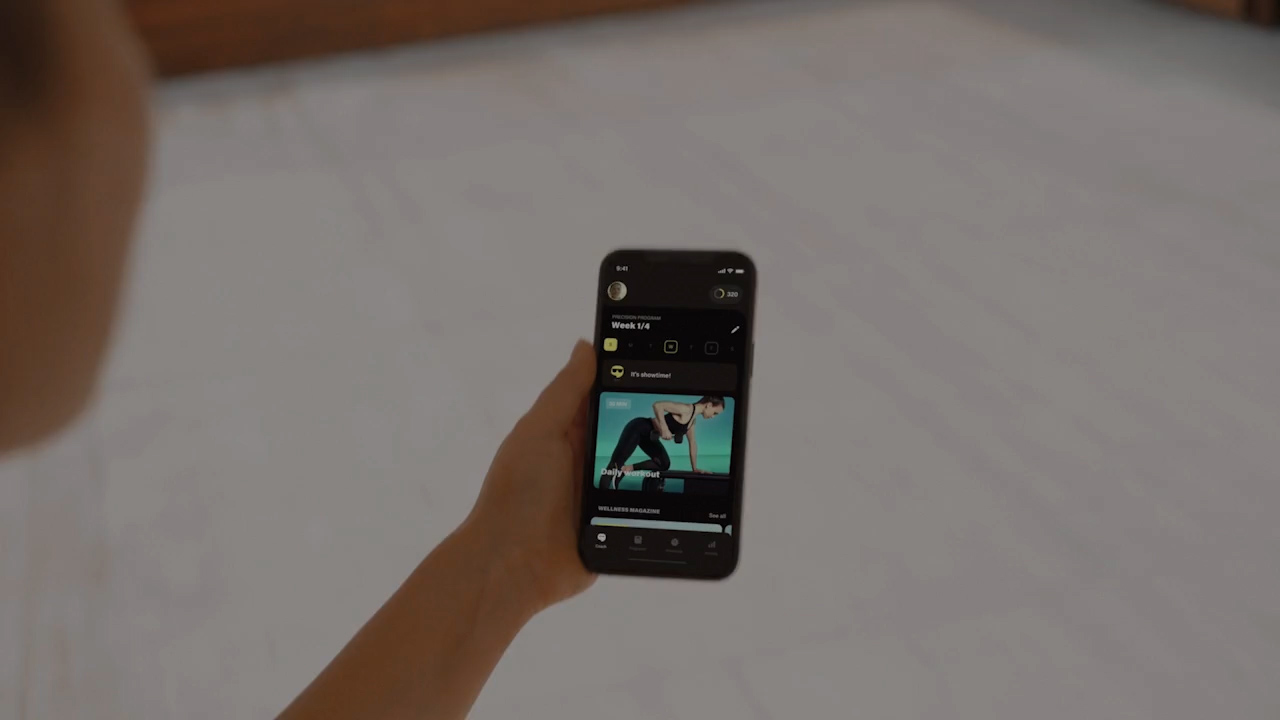
DOWNLOAD THE TECHNOGYM APP
Join the Technogym community and gain access to 1,000+ on-demand workouts, follow personalized training programs, and train with expert coaching and Technogym AI Coach guidance. Track your progress, take on challenges, and share your results to stay motivated.