

September 14, 2026
Progressive overload guide: the science of muscle and strength growth
To build muscle and strength, you must systematically challenge your musculoskeletal system; training without a structured progression leads directly to stagnation. This progressive overload guide breaks down the physiological rules of resistance training, giving you the practical tools to adjust volume and intensity safely, map out long-term adaptation, and leverage connected technology to eliminate guesswork from your fitness routine.

The physiological progressive overload definition and mechanism
At its core, defining progressive overload is simple: to make your muscles stronger and bigger, you must gradually increase the workload you place on them over time.
Physiologically, this works through two main mechanisms: first, your nervous system learns to communicate better with your muscles, recruiting more motor units and firing them faster to generate more force; second, the physical tension of lifting heavier weights acts as a mechanical signal that triggers muscle protein synthesis, causing your muscle fibers to adapt by becoming thicker and stronger during recovery.
If you keep lifting the exact same weight for the same repetitions week after week, your body has no biological reason to change, which is why a gradual increase in challenge is the only way to avoid hitting a progress plateau.
Physiologically, this works through two main mechanisms: first, your nervous system learns to communicate better with your muscles, recruiting more motor units and firing them faster to generate more force; second, the physical tension of lifting heavier weights acts as a mechanical signal that triggers muscle protein synthesis, causing your muscle fibers to adapt by becoming thicker and stronger during recovery.
If you keep lifting the exact same weight for the same repetitions week after week, your body has no biological reason to change, which is why a gradual increase in challenge is the only way to avoid hitting a progress plateau.

Core variables in progressive overload training
Successfully applying progressive overload training means manipulating the three core levers of program design. Instead of just adding weight, you can systematically challenge your muscles by adjusting:
IN SHORT:
- Volume: the total workload of your training, calculated by multiplying your total sets, repetitions, and the weight lifted (sets x reps × load).
- Intensity: how hard you are working, typically measured by the amount of weight or how close you get to muscular failure (%1RM, RPE).
- Frequency: how often you train a specific muscle group or lift within a weekly cycle (e.g., training chest once vs. twice a week).
ADJUSTING VOLUME, INTENSITY, AND FREQUENCY SAFELY
To make your routine progress safely, you must change only one variable at a time using clear, practical progression methods:- How to progress volume: if you easily complete 3 sets of 8 reps with a weight, progress next week by trying to complete 3 sets of 10 reps with the exact same weight, or by adding a 4th set of 8 reps to increase your total workload.
- How to progress intensity: once you master a weight for your target repetitions, increase the load by a conservative 2% to 5% (for example, adding 5 lb to a 135 lb bench press) while keeping your total sets and reps identical.
- How to progress frequency: if you currently train your legs only on Mondays with high volume, you can progress by splitting that same total volume into two shorter, higher-energy sessions on Mondays and Thursdays, allowing you to lift with better quality and heavier weights.
IN SHORT:
- Adjust volume, intensity, or frequency
- Change only one of the previous variables at a time
- Prioritize technique
- Use structured rest periods
How to apply progressive overload in your weekly routine
A successful progressive overload workout plan is essentially a roadmap that balances hard work with strategic recovery to keep your progress climbing over months rather than just days. To achieve real, lasting results, you must look beyond the single workout and learn how to structure progressive overload across a full training block, or mesocycle, which typically lasts between four to six weeks.
Within this cycle, you do not simply throw more weight on the bar every session; instead, you build a wave of progression where the demand gradually increases week by week. Typically, the first three to four weeks of a mesocycle are dedicated to slowly accumulating training volume—either by adding reps or keeping execution tempos slower—which forces your body to build endurance and structural capacity. Once this foundation is laid, you transition into a higher-intensity phase where you safely increase the weight while slightly reducing the reps, culminating in a planned "deload" week to let your nervous system fully recover and bounce back stronger for your next training block.
Within this cycle, you do not simply throw more weight on the bar every session; instead, you build a wave of progression where the demand gradually increases week by week. Typically, the first three to four weeks of a mesocycle are dedicated to slowly accumulating training volume—either by adding reps or keeping execution tempos slower—which forces your body to build endurance and structural capacity. Once this foundation is laid, you transition into a higher-intensity phase where you safely increase the weight while slightly reducing the reps, culminating in a planned "deload" week to let your nervous system fully recover and bounce back stronger for your next training block.
How to design a progressive overload workout plan for long-term adaptation:
- Think in blocks: 4- 6-week mesocycles are great ways to organize your training
- Ride the wave: build volume first, then ramp up the intensity
- Plan your rest: always include a deload week at the end of the cycle
Practical execution within progressive overload strength training
Putting progressive overload strength training into practice requires a disciplined shift in mindset from simply sweating to systematically measuring your efforts. Real progress is built on consistency and precision, which means you must perform every single exercise with identical, high-quality form before you even think about increasing the difficulty.
When you stabilize your movement patterns and eliminate momentum, you ensure that the target muscle groups—rather than your joints and ligaments—are absorbing the mechanical tension, creating a safe and reliable baseline from which you can gradually layer on more physical challenges over your training cycle.
When you stabilize your movement patterns and eliminate momentum, you ensure that the target muscle groups—rather than your joints and ligaments—are absorbing the mechanical tension, creating a safe and reliable baseline from which you can gradually layer on more physical challenges over your training cycle.

Specific tracking: progressive overload for bench press performance
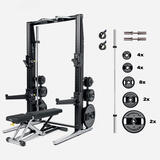
The bench press provides an effective example of how to apply progressive overload in a structured way, offering a model that can be replicated across any compound, multi-joint exercise.
Because the bench press heavily recruits your chest, shoulders, triceps, and central nervous system, progress will not be linear, making detailed tracking of your working weight, total repetitions, and perceived exertion essential.
By keeping a simple training log of your bench press sessions, you can identify when to make a conservative weight jump, when to focus on explosive power off the chest, or when to simply improve your shoulder blade stability, allowing you to build upper-body strength step-by-step while protecting your rotator cuffs from overuse.
To visualize how these variables interact in a real-world scenario, examine the 4-week training template below, which demonstrates how to systematically progress on the bench press without relying solely on adding raw weight to the barbell.
Because the bench press heavily recruits your chest, shoulders, triceps, and central nervous system, progress will not be linear, making detailed tracking of your working weight, total repetitions, and perceived exertion essential.
By keeping a simple training log of your bench press sessions, you can identify when to make a conservative weight jump, when to focus on explosive power off the chest, or when to simply improve your shoulder blade stability, allowing you to build upper-body strength step-by-step while protecting your rotator cuffs from overuse.
To visualize how these variables interact in a real-world scenario, examine the 4-week training template below, which demonstrates how to systematically progress on the bench press without relying solely on adding raw weight to the barbell.
| Week | Focus of the Week | Target Sets & Reps | Load (lbs) | Total Volume | Rest Interval |
|---|---|---|---|---|---|
| Week 1 | Baseline Strength | 3 x 8 | 135 lbs | 24 reps | 2:00 min |
| Week 2 | Volume Progression | 1 x 9, 2 x 8 | 135 lbs | 25 reps (+1) | 2:00 min |
| Week 3 | Density & Quality | 3 x 8 | 135 lbs | 24 reps | 1:30 min (shorter rest) |
| Week 4 | Intensity Progression | 3 x 8 | 140 lbs (+5 lbs) | 24 reps | 2:00 min |
Avoiding plateaus in progressive overload weight training
Hitting a wall in your progressive overload weight training can feel incredibly frustrating, especially when you are putting in the hours, prepping your meals, and doing everything right on paper. When the weights suddenly feel heavier and your motivation begins to plummet, it is easy to fall into the psychological trap of trying to force your way through by lifting with angry, compromised form—but this is precisely where plateaus are conquered or injuries are born.
Real, sustainable progress requires you to shift your perspective and embrace the "deload" week not as a step backward or a sign of weakness, but as a strategic, planned pause that allows your body to rebuild. By intentionally dropping your training weights by thirty percent for a single week, you quiet the systemic fatigue in your joints and mind, giving your central nervous system the breathing room it needs to recover so you can return to the gym hungry, focused, and physically prepared to shatter your old limits.
Real, sustainable progress requires you to shift your perspective and embrace the "deload" week not as a step backward or a sign of weakness, but as a strategic, planned pause that allows your body to rebuild. By intentionally dropping your training weights by thirty percent for a single week, you quiet the systemic fatigue in your joints and mind, giving your central nervous system the breathing room it needs to recover so you can return to the gym hungry, focused, and physically prepared to shatter your old limits.
Tracking systems and managing systemic neural fatigue
While pushing your limits is essential for long-term growth, the true engine of sustainable progress lies in your ability to manage systemic neural fatigue and accurately track your training metrics week over week.
Because heavy lifting puts an immense demand on your central nervous system, pushing too hard for too long can lead to joint pain, poor sleep, and a sudden drop in physical performance—symptoms that indicate your recovery is lagging behind your training.
Utilizing a dedicated physical or digital tracking system to log your sets, reps, sleep quality, and rating of perceived exertion (RPE) will allow you to make objective, data-driven decisions, helping you identify exactly when to push for a new personal record and when to back off for a well-deserved recovery phase.
Because heavy lifting puts an immense demand on your central nervous system, pushing too hard for too long can lead to joint pain, poor sleep, and a sudden drop in physical performance—symptoms that indicate your recovery is lagging behind your training.
Utilizing a dedicated physical or digital tracking system to log your sets, reps, sleep quality, and rating of perceived exertion (RPE) will allow you to make objective, data-driven decisions, helping you identify exactly when to push for a new personal record and when to back off for a well-deserved recovery phase.
Mastering progressive overload with the Technogym Ecosystem
The ultimate shortcut to flawless progressive overload lies in replacing manual gym diaries with a fully connected training environment, a capability seamlessly brought to life by the Technogym Ecosystem.
Your journey begins with Technogym Checkup, an advanced assessment station designed to measure key wellness parameters, including strength, mobility, and posture, providing an objective baseline from which to build your training journey.
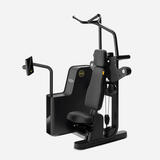
When you step onto the smart strength floor, the revolutionary Biostrength line takes over: these AI-driven machines feature adaptive resistance and automatically guide you through maximum strength tests (1RM) and configures advanced loading techniques like eccentric overloads, stripping, or hyper-focused tempo training.
Every single kilogram you move, rep you complete, and performance metric you achieve is instantly synced to Technogym App, which acts as an active digital coach by tracking your long-term volume trends and proposing automatic, algorithmic load progressions that guarantee safe, scientifically backed adaptations without you ever having to guess what weight to pin next.
Your journey begins with Technogym Checkup, an advanced assessment station designed to measure key wellness parameters, including strength, mobility, and posture, providing an objective baseline from which to build your training journey.
When you step onto the smart strength floor, the revolutionary Biostrength line takes over: these AI-driven machines feature adaptive resistance and automatically guide you through maximum strength tests (1RM) and configures advanced loading techniques like eccentric overloads, stripping, or hyper-focused tempo training.
Every single kilogram you move, rep you complete, and performance metric you achieve is instantly synced to Technogym App, which acts as an active digital coach by tracking your long-term volume trends and proposing automatic, algorithmic load progressions that guarantee safe, scientifically backed adaptations without you ever having to guess what weight to pin next.



Evolve your strength
Mastering individual training principles is the key to unlocking your true physical potential. To see how these variables fit into a complete, elite-level program and to build a bulletproof physical foundation, check out our comprehensive strength training guide and take your performance to the next level today.

More on strength


Delivering education and training experiences
An exclusive, world‑class hub empowering wellness, fitness, sport, and health experts with research‑driven learning experiences. From immersive programs to international workshops and certifications, it connects a global community of professionals and thought leaders, shaping the future of the industry.