

5 positive effects of unilateral exercises on muscle chains
When it comes to endurance training, most movements fall into two categories: unilateral training and bilateral training. Unilateral training is not a new concept, but its popularity in the field of strength and conditioning has exploded in recent years. There are many positive aspects to unilateral training, but does this mean that bilateral training should be considered inferior? Let's take a closer look at unilateral exercises and see how they should adapt to the routine.

5 advantages of unilateral exercises on muscle chains
Single leg exercises are often the least appreciated and underused training mode in sports performance, probably because they can be very difficult. However, once the athlete feels comfortable with the movements, these exercises can have an excellent carry-over to prevent injury and increase performance. If we look at any athletic movement, or even just the act of walking down the street, we'll quickly see that it's simply a one-legged, repeated movement. Or again, if we look at a still image of a marathon runner or a sprinter, we will see a single leg supports all the body's weight.
ADVANTAGE 1: Sports are played on one leg only
This may seem a bit strange, but in general, any sport that involves running will require you to perform most of the actions on one leg. If we are trying to make our training specific to athletics, then it makes sense to train only one leg at a time because this reflects more accurately what the athlete will be required to perform on the field.
All this demonstrates the need for stability of the single leg and how greater production of force on one leg can lead to faster times in the success of the exercise. In addition, structural stability of the knee is essential to prevent serious injury and the only way to build it is through endurance training and more specifically isolated endurance training.
For example, if a back run makes a clean cut in the backfield, one leg will have to support and produce strength up to twice the athlete's body weight. If the leg, from the ankle to the hip, cannot absorb and produce this kind of force, an injury is inevitable.
Here are 3 single leg exercises that every athlete should use to develop strength and stability, factors that will quickly affect performance.
All this demonstrates the need for stability of the single leg and how greater production of force on one leg can lead to faster times in the success of the exercise. In addition, structural stability of the knee is essential to prevent serious injury and the only way to build it is through endurance training and more specifically isolated endurance training.
For example, if a back run makes a clean cut in the backfield, one leg will have to support and produce strength up to twice the athlete's body weight. If the leg, from the ankle to the hip, cannot absorb and produce this kind of force, an injury is inevitable.
Here are 3 single leg exercises that every athlete should use to develop strength and stability, factors that will quickly affect performance.
Step-Ups
Step-Ups are an excellent type of exercise where you use a single leg to climb on a plyobox or bench. Not only do they develop strength and size in the quadriceps, buttocks, hip flexors and posterior thigh muscles, but they also significantly challenge the central musculature because of the pelvic stability needed to perform the movement. If performed correctly they are an excellent exercise to improve athletic performance.
You can load the movement with barbells, dumbbells, and kettlebells. Trying to use a weight that is demanding, but that also allows you to perform 3-4 sets of 3-6 reps.
You can load the movement with barbells, dumbbells, and kettlebells. Trying to use a weight that is demanding, but that also allows you to perform 3-4 sets of 3-6 reps.
Pistol Squat
To make a Pistol Squat, you'll need a high degree of strength and stability for one leg. Part of the beauty of this exercise is that most people don't need extra weight to reap the benefits. It may be necessary to use suspension training straps such as Omnia dual lift to assist performance of this exercise initially.
Try to perform 3-4 sets of 3-6 reps on each leg.
Try to perform 3-4 sets of 3-6 reps on each leg.
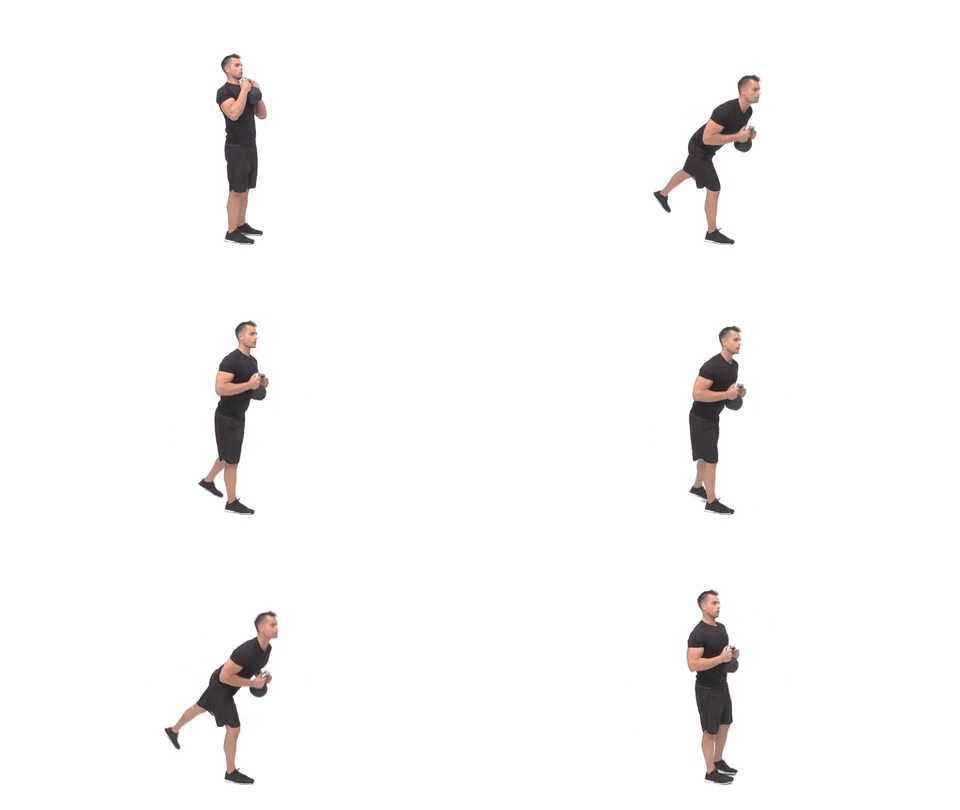
Single Romanian Deadlifts (RDL)
Single leg RDLs are a powerful exercise. They develop the strength of the single leg which must be explosive together with the other leg during sprinting, jumping and changing direction. They also focus on the buttocks and back thigh muscles, which are the main drivers of the above skills. They also help to eliminate imbalances of strength and improve the stability of the lower body, protecting the knees from injuries.
You need to use a weight that is demanding, but that also allows you to perform 3-4 sets of 3-6 reps on each leg.
You need to use a weight that is demanding, but that also allows you to perform 3-4 sets of 3-6 reps on each leg.

Advantage 2: formation of balance and stability of the core
During unilateral movements of the lower body, the individual must produce strong contractions while standing on one leg. This requires more proprioception and central stability than bilateral movements. The same applies to unilateral movements of the upper body, as the core must function to prevent the trunk from rotating unnecessarily during a push or pull exercises.
A 2012 study in the European Journal of Applied Physiology found that unilateral exercises activate the muscles of the superficial core more effectively than bilateral exercises.
A 2012 study in the European Journal of Applied Physiology found that unilateral exercises activate the muscles of the superficial core more effectively than bilateral exercises.

Advantage 3: Each part must do an equal amount of work
Athletes often have muscle imbalances due to the nature of the sport, as each has a dominant arm or a dominant leg and in performing bilateral exercises, we rely many times on the stronger side to perform more work. For example, if you perform a heavy Back Squat, it is natural that the stronger leg contributes more significantly to the exercise than the weaker limb.
One-sided training avoids this problem by forcing you to work on both sides in isolation. When training unilaterally, we cannot rely on the stronger side to compensate for the lack of strength of the weaker side. This eventually helps to reduce muscle imbalances throughout the body.
One-sided training avoids this problem by forcing you to work on both sides in isolation. When training unilaterally, we cannot rely on the stronger side to compensate for the lack of strength of the weaker side. This eventually helps to reduce muscle imbalances throughout the body.

Advantage 4: Effect of cross-education and rehabilitation
Through a phenomenon known as cross-education, unilateral exercises also strengthen the "unused" side of the body. Training a limb can cause strength gains in the untrained contralateral limb. Essentially, unilateral exercises can increase strength in a limb without training it directly.
Unilateral exercises can eliminate limiting factors, allowing you to better focus on building strength in the limb.
Unilateral exercises can eliminate limiting factors, allowing you to better focus on building strength in the limb.
Advantage 5: Generally, you will not be limited by your core or grip
Michael Boyle talks about this concept in his book New Functional Training for Sports.
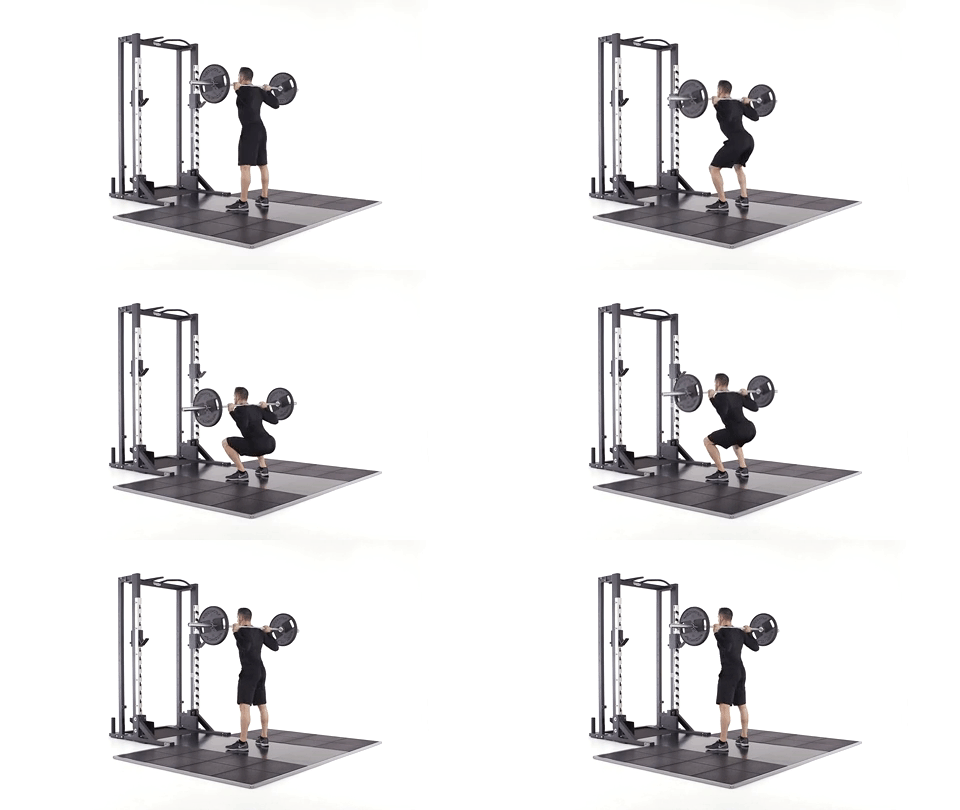
Unilateral exercises are generally limited only by the limb doing the work. For example, in a Split Squat, the legs will tire or give in before the lower back. But in a bilateral Back Squat, the weakest link may well be the lower back. Unilateral exercises can eliminate limiting factors, allowing you to better focus on building strength in the limb.
Unilateral exercises are generally limited only by the limb doing the work. For example, in a Split Squat, the legs will tire or give in before the lower back. But in a bilateral Back Squat, the weakest link may well be the lower back. Unilateral exercises can eliminate limiting factors, allowing you to better focus on building strength in the limb.
MORE TO READ




DOWNLOAD THE TECHNOGYM APP
Join the Technogym community and gain access to 1,000+ on-demand workouts, follow personalized training programs, and train with expert coaching and Technogym AI Coach guidance. Track your progress, take on challenges, and share your results to stay motivated.