

July 24, 2025
Strength Training for Runners: The Key to Improving Speed and Running Economy
The stronger your muscles are, the more force you can generate while running; let’s find out all the reasons why strength training is likely to improve running economy.

A Brief Overview
Strength training - especially heavy lifting and plyometrics - makes runners faster, more powerful, and more injury‑resistant, often with just a small weekly time investment. Integrating it into a running routine is a highly effective way to improve speed and overall performance.
WHAT YOU NEED TO KNOW
- Stronger muscles generate more force with each stride, translating directly into more speed.
- Resistance training and plyometrics enhance running economy and overall performance.
- Heavy loads and single‑leg work build the strength and stability runners rely on.
- Just 2 sessions per week can produce measurable gains in power, resilience, and efficiency.

There’s this saying: to become a better runner, you have to run more. While that may be true, it’s also an oversimplification. Becoming a better runner isn’t just about racking up miles—it requires eating enough to fuel all that activity, getting enough sleep to allow your body to recover properly from your workouts, incorporating flexibility and mobility practices so you move through a normal range of motion and get the most out of your stride, and so on and so on.
But if “better” means “faster” to you, strength training is a simple way to supercharge your speed while bulletproofing your body against injury—a win-win. Strength training with either high loads, plyometrics, or a combination of resistance training methods is likely to improve running economy—a measure of efficiency, or how much energy your body requires to sustain a certain speed—in middle- and long-distance runners, a systematic review and meta-analysis published in Sports Medicine in January 2024 found.
Yes, it can be tough to make time for strength training when all you want to do is hit the pavement, treadmill, or trail. But squeezing in a few sessions throughout your week (even if that means sacrificing an easy run!) will help you get faster sooner. Here’s how.
But if “better” means “faster” to you, strength training is a simple way to supercharge your speed while bulletproofing your body against injury—a win-win. Strength training with either high loads, plyometrics, or a combination of resistance training methods is likely to improve running economy—a measure of efficiency, or how much energy your body requires to sustain a certain speed—in middle- and long-distance runners, a systematic review and meta-analysis published in Sports Medicine in January 2024 found.
Yes, it can be tough to make time for strength training when all you want to do is hit the pavement, treadmill, or trail. But squeezing in a few sessions throughout your week (even if that means sacrificing an easy run!) will help you get faster sooner. Here’s how.
How does strength translate to speed?
Running is a highly repetitive sport. A 10-minute mile consists of about 1,700 steps, according to research published in ACSM's Health & Fitness Journal, and each one produces ground reaction forces that are, on average, two and a half times your body weight, the Clinical Journal of Sport Medicine reports.
That repetitive motion primes your muscles, bones and joints to absorb a certain amount of impact—but strength training can help increase what your body can withstand by further loading your tissues in a way that forces them to adapt and get stronger. The stronger your muscles are, the more force you can generate while running. And that ability to apply more force down to ground—AKA power— is where speed comes from: the more you can push off the ground with every step, the more distance you can cover in less time.
That repetitive motion primes your muscles, bones and joints to absorb a certain amount of impact—but strength training can help increase what your body can withstand by further loading your tissues in a way that forces them to adapt and get stronger. The stronger your muscles are, the more force you can generate while running. And that ability to apply more force down to ground—AKA power— is where speed comes from: the more you can push off the ground with every step, the more distance you can cover in less time.

No weights? No problem. Plyometric movements—explosive bodyweight exercises (think: squat jumps and burpees)—cause muscles to lengthen and shorten rapidly, a scenario that maximizes the muscle contraction and ultimately enhances muscle power. Runners who did plyo workouts twice a week for a month saw improved running economy, sprint speed, and time trials (or race performance), a 2018 review published in Sports Medicine found.
But strength training isn’t just about your muscles. It drives neuromuscular improvements, strengthening the mind-body connection so your brain can better recruit your muscles, essentially allowing you to tap into that power more quickly, that 2018 study from Sports Medicine determined. And working against heavy resistance bolsters your collagen, tendons, ligaments, and bones—all of which will help make you a more durable and resilient runner, and less likely to experience injuries. In fact, it could reduce the risk of overuse injury by up to 50 percent, according to an older meta-analysis published in the British Journal of Sports Medicine. The healthier you are, the more consistently you can train.
But strength training isn’t just about your muscles. It drives neuromuscular improvements, strengthening the mind-body connection so your brain can better recruit your muscles, essentially allowing you to tap into that power more quickly, that 2018 study from Sports Medicine determined. And working against heavy resistance bolsters your collagen, tendons, ligaments, and bones—all of which will help make you a more durable and resilient runner, and less likely to experience injuries. In fact, it could reduce the risk of overuse injury by up to 50 percent, according to an older meta-analysis published in the British Journal of Sports Medicine. The healthier you are, the more consistently you can train.

How to Incorporate Strength Training
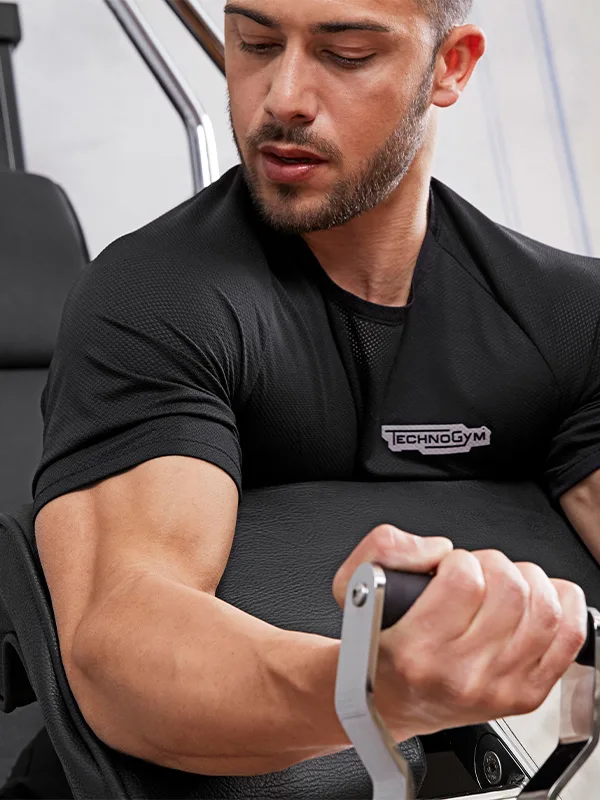
Strength training actually doesn’t require a huge time investment. A mere two sessions per week will get you stronger, according to a 2020 study published in the Journal of Strength and Conditioning Research, and those sessions can be short—just 30 to 60 minutes a week of strength training may be enough to see health benefits, a 2022 meta-analysis published in the British Journal of Sports Medicine determined. And using Biostrength—Technogym’s strength training line that uses artificial intelligence to help you dial in the correct load, sets, reps, and recovery time—will help you get 30 percent better results in the same amount of time compared to classic training with equipment or free weights.
Runners can maximize their time by prioritizing the six main exercise movement categories: push, pull, squat, hinge, carry, and rotate. These complex or compound movements involve multiple major muscle groups and typically multiple joints; these require various parts of your body to move together, just like running. Running-specific movement patterns—i.e. the hinge and squat—are especially important, and because running is essentially a series of jumps from one leg to the other, unilateral (or single-leg) exercises will help build the strength, power, and stability needed to propel the body forward. Upper body strength is important, too, when it comes to energy efficiency; a single session on the Technogym Skillup gives you complete upper body training.
Runners can maximize their time by prioritizing the six main exercise movement categories: push, pull, squat, hinge, carry, and rotate. These complex or compound movements involve multiple major muscle groups and typically multiple joints; these require various parts of your body to move together, just like running. Running-specific movement patterns—i.e. the hinge and squat—are especially important, and because running is essentially a series of jumps from one leg to the other, unilateral (or single-leg) exercises will help build the strength, power, and stability needed to propel the body forward. Upper body strength is important, too, when it comes to energy efficiency; a single session on the Technogym Skillup gives you complete upper body training.

When doing those moves, don’t shy away from heavy weights. For faster runners, training with loads higher than 80 percent of your one repetition maximum, or the most amount of weight you can lift for a single rep of any given exercise, is most effective in improving running economy, while plyometrics training might be effective for slower runners, that 2024 Sports Medicine review found. Doing higher reps with lower weights isn’t bad, but that approach will mostly improve muscular endurance—and runners have already got that covered through, well, running. Lifting heavy is the best option for making your muscles stronger, a 2021 review in the journal Medicine & Science in Sports & Exercise concluded.
Don’t expect to make gains overnight. Sports Medicine’s 2024 review looked at programs that lasted between six and 24 weeks and included one to four sessions executed per week. Some people might see improvements in aerobic capacity and muscle gains in just two to four weeks, according to a 2017 scientific review published in Cold Spring Harbor Perspectives in Medicine; others might take eight to 12 weeks. The key, as always, is to keep showing up. That dedication and consistency will eventually translate into results—and adding strength to your running routine is a surefire way to reach your goals faster than running alone.
Don’t expect to make gains overnight. Sports Medicine’s 2024 review looked at programs that lasted between six and 24 weeks and included one to four sessions executed per week. Some people might see improvements in aerobic capacity and muscle gains in just two to four weeks, according to a 2017 scientific review published in Cold Spring Harbor Perspectives in Medicine; others might take eight to 12 weeks. The key, as always, is to keep showing up. That dedication and consistency will eventually translate into results—and adding strength to your running routine is a surefire way to reach your goals faster than running alone.
Don’t miss these




DOWNLOAD THE TECHNOGYM APP
Join the Technogym community and gain access to 1,000+ on-demand workouts, follow personalized training programs, and train with expert coaching and Technogym AI Coach guidance. Track your progress, take on challenges, and share your results to stay motivated.
When doing those moves, don’t shy away from heavy weights. For faster runners, training with loads higher than 80 percent of your one repetition maximum, or the most amount of weight you can lift for a single rep of any given exercise, is most effective in improving running economy, while plyometrics training might be effective for slower runners, that 2024 Sports Medicine review found. Doing higher reps with lower weights isn’t bad, but that approach will mostly improve muscular endurance—and runners have already got that covered through, well, running. Lifting heavy is the best option for making your muscles stronger, a 2021 review in the journal Medicine & Science in Sports & Exercise concluded.
Don’t expect to make gains overnight. Sports Medicine’s 2024 review looked at programs that lasted between six and 24 weeks and included one to four sessions executed per week. Some people might see improvements in aerobic capacity and muscle gains in just two to four weeks, according to a 2017 scientific review published in Cold Spring Harbor Perspectives in Medicine; others might take eight to 12 weeks. The key, as always, is to keep showing up. That dedication and consistency will eventually translate into results—and adding strength to your running routine is a surefire way to reach your goals faster than running alone.
Don’t expect to make gains overnight. Sports Medicine’s 2024 review looked at programs that lasted between six and 24 weeks and included one to four sessions executed per week. Some people might see improvements in aerobic capacity and muscle gains in just two to four weeks, according to a 2017 scientific review published in Cold Spring Harbor Perspectives in Medicine; others might take eight to 12 weeks. The key, as always, is to keep showing up. That dedication and consistency will eventually translate into results—and adding strength to your running routine is a surefire way to reach your goals faster than running alone.